

Introduction
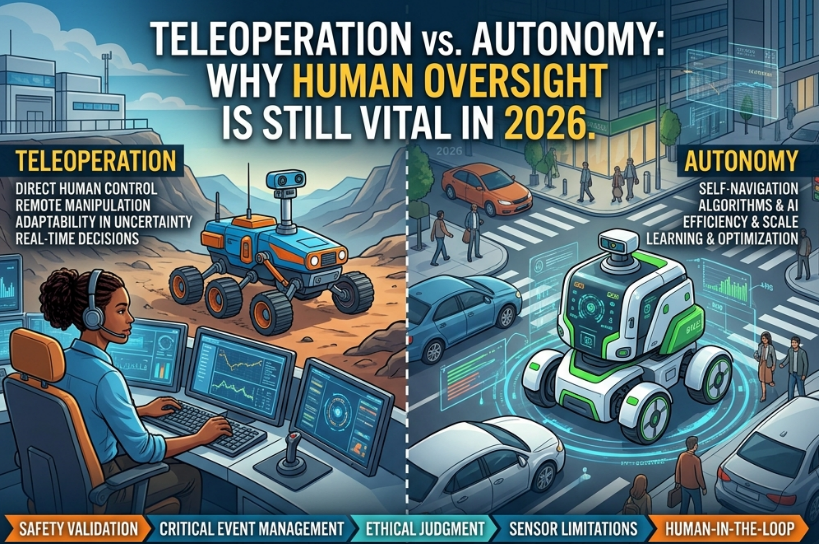
As we approach 2026, the landscape of automation is rapidly evolving. The conversation around artificial intelligence (AI) and its impact on various industries often centers on the seemingly inevitable rise of fully Autonomous Systems. AI is exciting because it can drive cars by itself and even help with surgeries all on its own. However, this progress often overshadows a critical component that remains indispensable: human oversight. While AI models are becoming increasingly sophisticated, the inherent unpredictability of the real world, coupled with ethical considerations and the need for nuanced judgment, necessitates a symbiotic relationship between human control and machine autonomy. This article delves into why, even in 2026, teleoperation is not merely a fallback but a vital strategic imperative, enhancing the capabilities and reliability of Autonomous AI Systems.
What is Teleoperation?
Teleoperation refers to the remote control and guidance of robotic systems by human operators. This can range from direct, real-time manipulation of a robot’s actions to providing high-level commands or intervening during specific, challenging phases of an operation. Teleoperation lets people control robots from far away, using their skills wherever the robot is working. This includes tasks such as remote navigation support for autonomous vehicles, manual intervention during critical safety situations for autonomous robots, and continuous monitoring of system performance for Autonomous Underwater Vehicles (AUVs). It ensures that robots can adapt quickly when automation alone is insufficient, leveraging human intuition and decision-making in complex scenarios. The human-in-the-loop AI market is expected to grow from $2.4 billion in 2025 to $11.8 billion by 2034, with a yearly growth rate of 19.3%, highlighting the increasing value of human input in AI systems.
What is Autonomy?
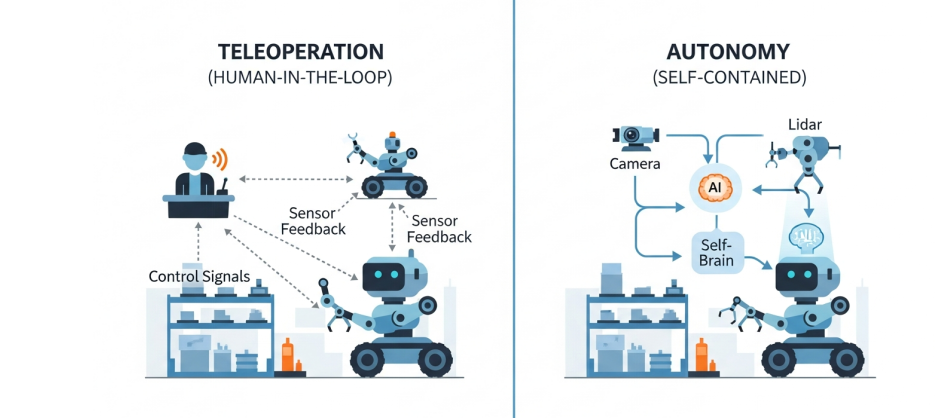
Teleoperation needs a person to control it, but Autonomy makes decisions on its own.
Robots and AI can do tasks and make decisions on their own without needing people to help them. You can do this by using smart software, AI, and sensors that help the system understand what’s around it. Smart systems use advanced tech like machine learning and clever algorithms to handle data and get things done. These systems work really well for tasks that involve repetition, structure, and lots of data, allowing for lots of AI automation and the ability to handle more work easily. These systems are designed to work on their own, which makes them great for jobs where people can’t be there, it’s risky, or it’s not practical.
The Limitations of Full Autonomy
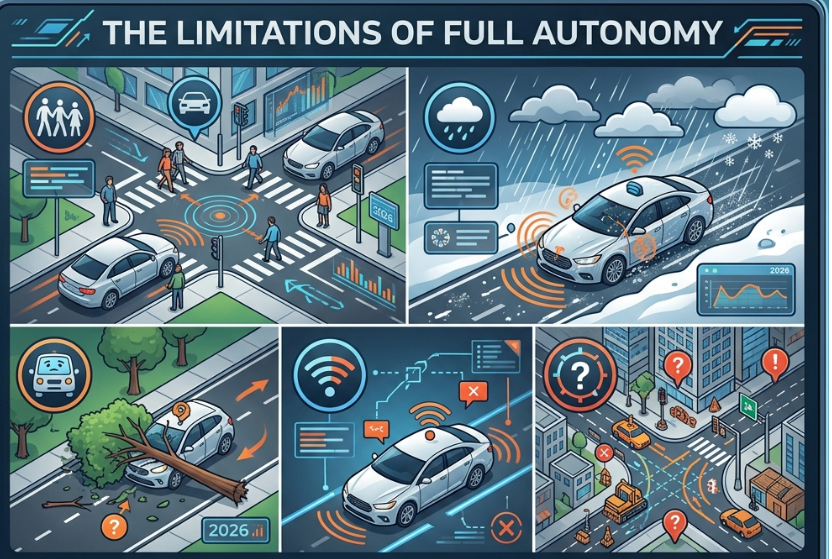
Even though AI and robots have come a long way, making them work on their own in every situation is still really tough. AI models, like LLMs and generative ones, find it tough to handle how complex and unpredictable the real world is. Machines can’t yet fully match how humans understand things and make decisions. You can really notice this gap when systems face new situations, need detailed decisions, or work in places different from their training.
1. Real-Time Decision-Making in Complex Situations
The real world is rarely static or perfectly predictable. Robots, even the smart ones, can mess up when something unexpected happens. Surprises like unexpected obstacles, changes in the environment, or tricky human interactions. For example, a self-driving car might come across a pedestrian acting unpredictably, or a robot in a warehouse might have to deal with multiple equipment failures. In such moments, the rigid logic of autonomous decision-making can be insufficient. People working as teleoperators can use their understanding and quick thinking to make important decisions on the spot, keeping things running smoothly and safely, which helps avoid expensive mistakes.
2. Enhanced Safety and Risk Management
In high-stakes industries such as healthcare, logistics, cybersecurity, and critical infrastructure management, safety is paramount. AI automation tries to make things more efficient, but even tiny mistakes can lead to big problems. AI hiccups led to $67.4 billion in losses globally in 2024, highlighting the big risks of using unreliable AI. Unosquare, 2026 Human oversight, through teleoperation, provides an essential layer of risk mitigation. Operators can watch how the system works, spot problems before they get worse, and step in to stop accidents or follow strict safety rules. Using human help is really important for handling risky situations and keeping things running smoothly, especially with important jobs or valuable stuff.
3. Improved System Reliability
Even the best self-driving systems can have problems like glitches, sensor mistakes, or misunderstandings in the data. Bad lighting, bad weather, or interference can mess up sensor input, causing mistakes in how things are perceived and leading to wrong decisions by autonomous systems. For complex operations, continuous monitoring is crucial. Teleoperation helps people check systems, find problems, and fix them right away. This method reduces the chances of robots stopping and keeps them working well. Studying how people use AI helps make AI models better, creating a cycle of continuous improvement and making the whole system more reliable. Robots that work on their own can face unexpected things when they interact with the real world.
4. Support for Emerging Robotics Applications
Robots are quickly moving into new areas like remote healthcare, precision farming, advanced security, and exploring the deep sea, and they often need both automation and human skills. Consider the deployment of Autonomous Underwater Vehicles (AUVs) for scientific research or infrastructure inspection; while these vehicles can autonomously map vast ocean floors, unexpected geological formations, or the discovery of delicate ecosystems necessitate human judgment for a nuanced response. Remote surgical robots need experienced surgeons to control them accurately from afar. These new examples show that we need systems that can use automation’s speed but still keep human flexibility and thinking.
5. Bridging the Gap Between Automation and Human Intelligence
Automation aims to help humans by making things easier, so we can focus on smarter tasks. Machines can do many tasks on their own, but they can’t think, create, or make ethical choices like humans can. By combining autonomy with teleoperation, businesses can achieve a powerful synergy. This approach lets AI do the simple and repetitive stuff, while people handle the more complicated thinking and decisions. This setup helps things work better and stay adaptable, while allowing us to use cool features like Physical Intelligence and Tactile Intelligence in daily situations, where it’s important for people to understand small physical interactions directly.
The Rise of Hybrid Robotics Models in 2026
By 2026, hybrid robotics models will not just become popular, but will also become the main approach. Robots and people are now working together more closely, not just doing routine tasks and supervising exceptions. More companies are using AI rules because they see the need for working together. These frameworks show who does what and when people need to step in or check things. Robots are getting really smart thanks to lots of training data, but they need regular fine-tuning and human input to work well in the real world. Using Autonomous AI Systems in this way lets businesses grow big and efficient, while still keeping important control, accuracy, and flexibility, especially for tricky jobs or surprising situations.
Why Businesses Are Investing in Teleoperation Solutions
The strategic decision for businesses to invest in teleoperation solutions in 2026 stems from a clear understanding of the limitations of pure autonomy and the tangible benefits of human-in-the-loop (HITL) systems. As AI gets better, the best companies know that human smarts are a key part of working well with machines. Putting money into remote control and monitoring services helps robots work their best and stay safe, whether they’re doing tricky tasks on their own or working with other automated systems. These solutions have skilled remote operators who can quickly step in, watch over the system nonstop, and fix problems right away, which helps get the most out of robotic assets. This approach helps reduce risks when AI makes decisions on its own, especially when it deals with new situations it might not understand well. As AI threats like self-operating attacks and tricky social scams get more common, having people watch over things is important for spotting, understanding, and defending against them, showing why teleoperation is key to keeping operations and data safe.
Conclusion
As we look towards 2026, the discourse surrounding artificial intelligence and automation will continue to be dominated by the advancements in Autonomous Systems. However, the narrative is shifting from a simple “autonomy versus human control” dichotomy to a more nuanced understanding of synergy. While AI models, including Transformer models and generative models, are becoming incredibly powerful, enabling sophisticated autonomous robotics and AI automation, they are not a panacea. The inherent unpredictability of real-world environments, the ethical complexities of autonomous decision making, and the ongoing quest for true Artificial General Intelligence (AGI) all point to the enduring necessity of human oversight.
Teleoperation, far from being a relic of a less advanced era, is evolving into a critical enabler of advanced AI. It is the mechanism that allows us to harness the power of autonomous vehicles, Autonomous Underwater Vehicles (AUVs), and other sophisticated Autonomous AI Systems while mitigating risks and ensuring safety. The development of robust AI governance frameworks must acknowledge this critical role. Furthermore, concepts like Physical Intelligence, Tactile Intelligence, and the refinement of a robot’s World Model through causal inference models and human feedback are areas where human expertise remains paramount.
The financial implications of AI errors, such as the billions lost to AI hallucinations, underscore the practical need for human validation. Businesses investing in teleoperation solutions are not just hedging against risk; they are strategically positioning themselves to leverage the full potential of AI. As multimodal models become more integrated and robot foundation models advance, the ability of humans to understand and direct these complex systems through model transparency and vigilant oversight will be a key differentiator. In 2026 and beyond, the most successful, safe, and ethical applications of AI will undoubtedly be those that embrace the power of human-machine collaboration, with teleoperation serving as the vital connective tissue. The future of intelligent systems is not one of pure machine dominance, but of optimized partnership, where human intent and oversight guide autonomous capabilities.
