

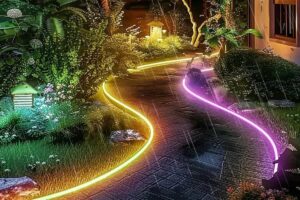
In the high-end architectural landscape of 2026, the demand for resilient outdoor lighting has reached an all-time high. As global weather patterns become increasingly volatile, homeowners and project managers are no longer satisfied with mere “weather resistance.” They are searching for the best LED lights for outside that can endure prolonged exposure to torrential rain, high humidity, and even temporary submersion.
At the heart of a storm-proof system is the waterproof LED strip. However, achieving true long-term reliability in a stormy climate requires more than just buying an IP65-rated product. It demands a sophisticated understanding of interface sealing technology, hydrostatic pressure management, and system-wide electrical stability. This comprehensive guide will explore how to design, install, and maintain an outdoor LED strip system that remains unshakeable through every monsoon and tropical storm.
The Anatomy of a High-Performance Waterproof LED Strip
To understand why some lights fail while others thrive, we must look at the structural engineering of the waterproof LED strip itself. In 2026, the industry has moved beyond simple plastic tubes to integrated material science.
Solid-Core Silicone Co-Extrusion
The most reliable outdoor LED strip products today utilize a process known as solid-core co-extrusion. Unlike older models where a strip was simply slid into a hollow PVC tube, co-extrusion involves encasing the entire PCB (Printed Circuit Board) in a solid block of high-grade silicone.
- Eliminating the “Dew Point”: In hollow tubes, air is trapped inside. When the temperature drops during a rainstorm, moisture in that air condenses into water droplets—the “Dew Point” effect. This internal condensation leads to corrosion. A solid-core waterproof LED strip has no air gaps, effectively eliminating internal fogging.
- Impact Resistance: Storms often bring flying debris. A solid silicone body provides a kinetic buffer, protecting the delicate LED diodes from physical impact that would shatter a glass or hard plastic fixture.
High-Ductility Copper Traces
Stability during the rainy season isn’t just about keeping water out; it’s about handling the physical stress of temperature shifts. Heavy rain causes rapid cooling of the strip. The best LED lights for outside feature thickened copper traces (3oz or 4oz copper) that can expand and contract without cracking, ensuring the electrical path remains unbroken despite thermal shock.
Interface Sealing: The Battle for the Connection Point
The most common failure in any outdoor LED strip installation occurs at the connection. No matter how waterproof the strip itself is, if the interface is weak, the system is doomed.
The “Over-Molded” Factory Advantage
For maximum stability in stormy climates, the best LED lights for outside utilize Injection Over-Molded Connectors.
- The Fusion Process: In the factory, the cable and the waterproof LED strip are placed into a high-pressure mold. Molten silicone is injected, chemically fusing the cable jacket to the strip housing.
- Molecular Integrity: This creates a monolithic seal. There is no “joint” for water to penetrate, making these connections far superior to any hand-glued end cap. For projects in hurricane-prone zones, over-molding is the only way to guarantee a true IP68 rating.
Professional On-Site Potting Techniques
When custom lengths are necessary, installers must replicate factory-level sealing. This is done through Silicone Potting.
- The Technique: After soldering the wires to the outdoor LED strip, the connection is placed in a transparent end-cap. A neutral-cure, waterproof silicone gel is injected to fill every cubic millimeter of space.
- The Result: The gel displaces all oxygen and moisture. This “encapsulation” ensures that the electrical contact is never exposed to the humid, acidic air of a storm, maintaining the stability of your waterproof LED strip for years.
Managing Hydrostatic Pressure and Humidity
Rainy seasons aren’t just about water; they are about pressure. During a heavy downpour, water can “pool” in certain areas, exerting hydrostatic pressure on your lighting fixtures.
The IP68 Submersion Standard
For ground-level installations or step lighting, an outdoor LED strip must be rated IP68.
- What IP68 Truly Means: It means the strip can be continuously submerged. In a stormy climate, garden beds can turn into temporary ponds. If your best LED lights for outside are only IP65, the pressure of standing water will eventually force moisture through the seals.
- Depth Ratings: Always check the depth rating of your waterproof LED strip. Most professional-grade strips are rated for 1m to 2m of submersion, which is more than enough to survive a flash flood.
Anti-Wicking Cables (The “Internal Dam”)
A little-known fact is that water can enter a light through the inside of the power cable. Through capillary action, moisture travels along the copper strands like a straw.
- The Solution: High-quality outdoor LED strip systems use “Anti-Wicking” or “Anti-Capillary” cables. These cables feature a waterproof barrier inside the wire insulation, ensuring that even if the power supply end is exposed to rain, the moisture cannot travel down the wire to the LEDs.
Electrical Stability: Surviving the Storm’s Surge
Waterproofing is only half the battle; the other half is surviving the electrical instability caused by lightning and grid fluctuations during storms.
Surge-Protected Power Supplies
The power supply (driver) is the “heart” of your waterproof LED strip system. During the rainy season, lightning strikes can induce massive voltage spikes in outdoor circuits.
- Integrated TVS (Transient Voltage Suppressors): The best LED lights for outside are paired with drivers that have built-in surge protection (4kV to 6kV). This protects the delicate LEDs on your outdoor LED strip from being “fried” by an indirect lightning strike.
- IP67 Driver Encapsulation: Always use a fully potted (epoxy-filled) driver. This prevents internal condensation within the power supply, which is a common cause of “tripping” breakers during humid nights.
The Importance of 24V DC Systems
For stormy environments, 24V systems are significantly more stable than 12V systems.
- Voltage Drop Management: In wet weather, minor corrosion at connection points can increase resistance. 24V waterproof LED strip systems handle this resistance much better, ensuring consistent brightness from the first meter to the last.
- Safety First: Low-voltage (24V) systems are inherently safer in wet conditions, significantly reducing the risk of electrical shock if a cable is accidentally damaged during garden maintenance.
Architectural Installation: Designing for Drainage
The longevity of your outdoor LED strip also depends on how it interacts with the architecture of your home.
The “Drip Loop” Engineering
This is a simple yet vital technique used by professional installers. Every cable that enters a junction box or building should have a “Drip Loop”—a small U-shaped dip in the wire. Gravity forces the water to follow the wire to the bottom of the “U” and drip off, rather than following the wire directly into the seal of your waterproof LED strip.
Sub-Surface Drainage for Aluminum Channels
If you are mounting your outdoor LED strip in an aluminum profile on the ground:
- The Drainage Hole Rule: Drill small 5mm drainage holes every 30cm in the bottom of the aluminum channel. This prevents the strip from “swimming” in stagnant water for days after a storm, which can lead to “Hydrolysis” (the chemical breakdown of the silicone jacket).
- Gravel Base: Place a layer of gravel beneath the channel to facilitate water percolation into the soil.
Maintenance: Ensuring Decades of Brilliance
Even the best LED lights for outside require a “health check” after a particularly brutal rainy season.
The Post-Storm Inspection
- Debris Clearing: Wet leaves and mud can trap heat. Once the storm passes, wipe down your waterproof LED strip to ensure it can dissipate heat properly.
- Junction Box Check: Open your outdoor junction boxes once a year to check for “spidering” or moisture trails. If you see signs of dampness, reseal the box with a silicone gasket or potting gel.
- Visual Color Check: If a segment of your outdoor LED strip appears slightly yellowed or dim, it may be a sign of “micro-leaks.” Replacing a 1m section now is much cheaper than replacing a 20m run later.
Conclusion: Investing in Weather-Hardened Excellence
In 2026, the rainy season shouldn’t be something you fear—it should be a time to appreciate the resilience of your design. By choosing a high-quality waterproof LED strip and focusing on the critical engineering of the interfaces, you are creating a landscape that stands the test of time.
Focus on the three pillars of storm-proof lighting: Material Quality (Silicone), Interface Integrity (Over-molding), and System Safety (Surge Protection). When you invest in the best LED lights for outside, you aren’t just buying illumination; you are buying peace of mind. Let your garden shine through the heaviest clouds and the strongest winds, serving as a beacon of reliable, beautiful engineering.
