

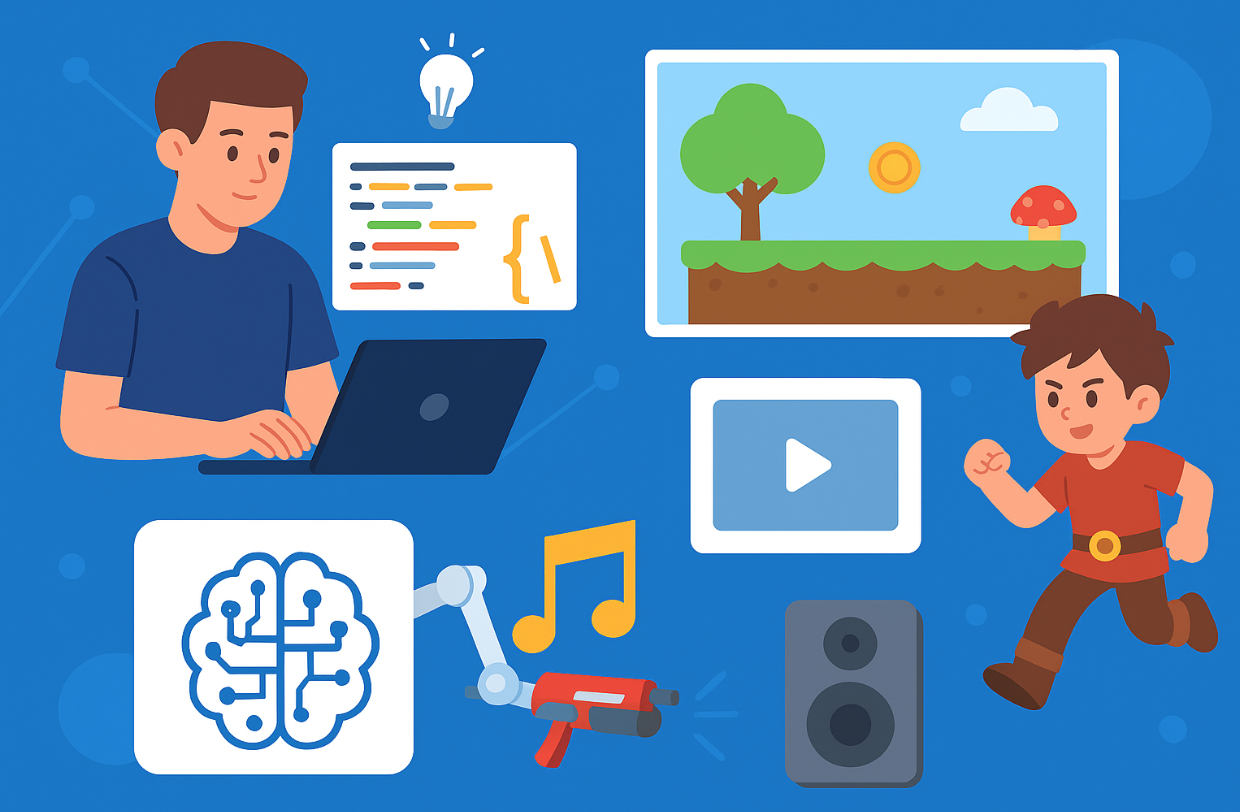
You have got a killer idea for a video game swirling in your head, a quirky puzzle adventure or a fast-paced endless runner that could hook players for hours. But then reality hits. You don’t have a team of coders, artists, or composers on speed dial. Budget? What’s that? And the learning curve for tools like Unity or Photoshop feels steeper than a mountain in The Legend of Zelda. Sound familiar? For years, these barriers have kept countless aspiring game developers on the sidelines, turning dreams into “someday” projects.
But here’s the good news: AI for game development is flipping the script. In 2025, artificial intelligence isn’t just a buzzword; it’s a trusty sidekick that’s democratizing the industry. No longer do you need a computer science degree or a fat wallet to prototype your game. AI tools are lowering the entry bar, letting beginners focus on what matters: their unique vision. Whether you’re scripting mechanics, crafting pixel-perfect art, weaving stories, or layering in sound, AI handles the heavy lifting so you can iterate fast and ship your creation affordably.
In this guide, we’ll explore how AI tools for indie developers are transforming game development for beginners. We’ll break down practical applications in coding, asset creation, narrative design, and audio, complete with real-world examples and tips to get you started. By the end, you’ll see AI not as a crutch, but as a collaborator that amplifies your creativity. Let’s dive in and bridge that gap together.
Generating Code and Logic of Game with AI:
Let’s start with the scariest part for many new devs: coding. Writing scripts for player movement, enemy AI, or scoring systems can feel like decoding ancient hieroglyphs if you’re not a programmer. Enter AI in game design, tools that act like a virtual coding tutor, suggesting lines of code, fixing bugs, and even building entire modules based on plain English descriptions.
Think of AI as your personal pair programmer. Instead of staring at a blank editor, you describe what you want (“Make a character jump when I tap the screen, but only if they’re on the ground”), and it spits out functional C# or Python code ready for engines like Unity or Godot. This isn’t magic, it’s machine learning trained on millions of code snippets, predicting what you need next.
Key Tools to Try
- GitHub Copilot: Powered by OpenAI, this integrates seamlessly into Visual Studio Code or your IDE of choice. It autocompletes code as you type, turning vague ideas into robust functions. Great for game development for beginners because it explains its suggestions, helping you learn along the way.
- Tabnine: A privacy-focused alternative, Tabnine uses your project’s context to generate code. It’s lightning-fast for scripting game logic, like collision detection or procedural level generation.
The Benefits in Action
Speed is the biggest win. Prototyping a basic game loop that once took weeks can now happen in hours. AI also shines at debugging, paste an error message, and it suggests fixes with explanations. Plus, it’s a fantastic teacher: As you tweak the generated code, you’re building real skills without the frustration of starting from scratch.
Take indie dev Alex, a college student with zero coding experience. Using GitHub Copilot, Alex built a simple 2D platformer in a weekend. “I described the mechanics in comments, and Copilot filled in the gaps,” Alex shared on a dev forum. “It turned my doodle on a napkin into something playable.” Tools like these aren’t replacing jobs; they’re empowering solo creators to compete with big studios.
For a real-world taste of what’s possible, check out Pocket Pro on Astrocade, a sleek mobile game where players manage a virtual sneaker empire. This project, crafted by a hobbyist using AI-assisted scripting for inventory and trading logic, shows how beginners can launch polished titles without a dev team.
Creating Art and Assets on a Budget: Pixels and Polygons, AI-Style
Visuals are the soul of a game, but creating them? That’s often where passion projects stall. Commissioning art can cost hundreds per sprite sheet, and free asset packs from stores like itch.io or Unity Asset Store feel generic. Creating game assets with AI changes everything by turning text prompts into custom, high-quality visuals, royalty-free and tailored to your world.
Picture describing a neon-lit cyberpunk cityscape or a whimsical forest sprite, then watching AI generate variations in seconds. These tools use generative models like diffusion to blend styles, ensuring your assets fit your theme without hours in Blender or Photoshop.
Essential Tools for Visual Magic
- Midjourney: Discord-based and beginner-friendly, it excels at 2D concept art, backgrounds, and UI elements. Prompt it with “pixel art robot jumping over firewalls, cyberpunk style, 16-bit” for endless runner assets.
- Leonardo AI: Web-based with fine-tuning options, it’s perfect for consistent character sheets or 3D model bases. Upload a reference image, and it generates variations—ideal for iterating on your hero design.
- Luma AI: For 3D enthusiasts, this creates textured models from text or video inputs. Turn “steampunk mech warrior” into a rigged asset ready for import into Unreal Engine.
Why It Matters for Indies
The cost savings are huge, no more $50 Sprite packs that don’t quite match. Rapid prototyping means you can test visuals early, refining based on playtests. And it’s inclusive: You don’t need an art degree; just a vivid imagination.
Consider the “before and after” magic: Before AI, a beginner might sketch a rough character on paper. After? A prompt yields a vibrant, animated-ready sprite. (Imagine a simple line drawing transforming into a detailed elf archer; tools like Leonardo make this effortless.)
Approach fueled the creation of Dealership Dash, a vibrant racing-management hybrid on Astrocade. The dev, a non-artist teacher, used Midjourney to generate car designs and track environments, blending them seamlessly for a game that’s as eye-catching as it is fun. It’s proof that AI tools for indie developers can deliver pro-level polish on a shoestring.
Designing Immersive Worlds and Narratives: Storytelling Supercharged
A game’s heart beats in its story, the lore that pulls players in, the dialogues that make characters memorable. But world-building can lead to writer’s block, especially when you’re juggling code and art. AI steps in as a narrative co-writer, generating quests, backstories, and branching dialogues that feel organic and deep.
It’s like having a brainstorming buddy who never tires. Feed it your core concept (“A dystopian city where dreams are currency”), and it outputs plot outlines, character arcs, or even full quest lines. For dynamic elements, AI can simulate NPC conversations, adapting to player choices for replayability.
Top Tools for Tale-Spinners
- ChatGPT: The versatile king, prompt it for “Generate 5 quest ideas for a fantasy RPG involving lost artifacts” and get structured outlines with twists.
- Claude: Anthropic’s tool shines at ethical, detailed prose. Use it for lore bibles or dialogue trees that avoid clichés.
- Scenario: Tailored for games, it creates consistent character profiles and interactive story branches, integrating with tools like Twine for choice-based adventures.
Unlocking Deeper Engagement
Benefits? It overcomes creative droughts, adds layers to simple games (think Undertale-style depth without the solo grind), and scales storytelling for larger projects. New devs can experiment with genres they’d otherwise skip, like horror or RPGs, building confidence through iteration.
One student dev used Claude to flesh out a horror game’s haunted mansion lore, turning a basic walker into a narrative gem. “AI gave me the skeleton; I added the soul,” they said. This human-AI synergy ensures stories stay authentic while expanding possibilities.
Composing Audio Music and Sound Effects Without the Expertise
Sound design often gets overlooked, yet it’s what immerses players in the tension-building score in a boss fight or the satisfying “ding” of a level-up. Creating original audio requires DAWs like Ableton or sound libraries that eat budgets. AI generators produce custom tracks and effects from mood descriptions, no conservatory required.
Describe “upbeat chiptune for a retro platformer” or “eerie ambient drone for sci-fi exploration,” and AI composes loops or one-shots. These tools analyze vast music datasets to match tempo, key, and emotion, outputting exportable WAVs.
Soundtrack Saviors
- Soundraw: User-friendly for loops; select genre and mood, then tweak length or intensity. Perfect for adaptive music that evolves with gameplay.
- AIVA: Focuses on orchestral scores, ideal for epic fantasies. It generates full compositions you can refine or license.
- Epidemic Sound AI tools: Part of a larger library, their AI curates and remixes tracks, blending generated elements with pro stems for hybrid results.
Elevating the Experience
Affordability and speed mean every game gets a bespoke audio layer, boosting polish without hiring composers. It also encourages experimentation—test chiptune vs. synthwave for your runner in minutes.
A hobbyist crafting a mobile puzzler used Soundraw to score victory jingles, transforming a quiet prototype into an addictive earworm. As with visuals, it’s about augmentation: AI provides the canvas; you paint the emotion.
Conclusion:
From generating bug-free code with GitHub Copilot to conjuring cyberpunk sprites via Midjourney, brainstorming quests on ChatGPT, and scoring triumphs with Soundraw, AI for game development is the ultimate enabler. It’s tackling the hard code work, prototyping, assets, narratives, and audio, so you can pour energy into innovation. Remember, these tools shine brightest when guided by your spark; they’re collaborators, not creators, ensuring your game feels yours uniquely.
The industry is more accessible than ever, especially on Free AI game creation platforms like Astrocade that let you build and share with AI at the core. Whether you’re a student sketching ideas in a dorm or a parent stealing evenings for hobby coding, AI bridges the gap from concept to console.
Ready to play? Pick one tool, say, prompt to Astrocade for your hero’s portrait, and prototype a scene this week. What’s your game dream? Drop it in the comments below; let’s inspire each other. The future of indie games is bright, and with AI, it’s in your hands.
