

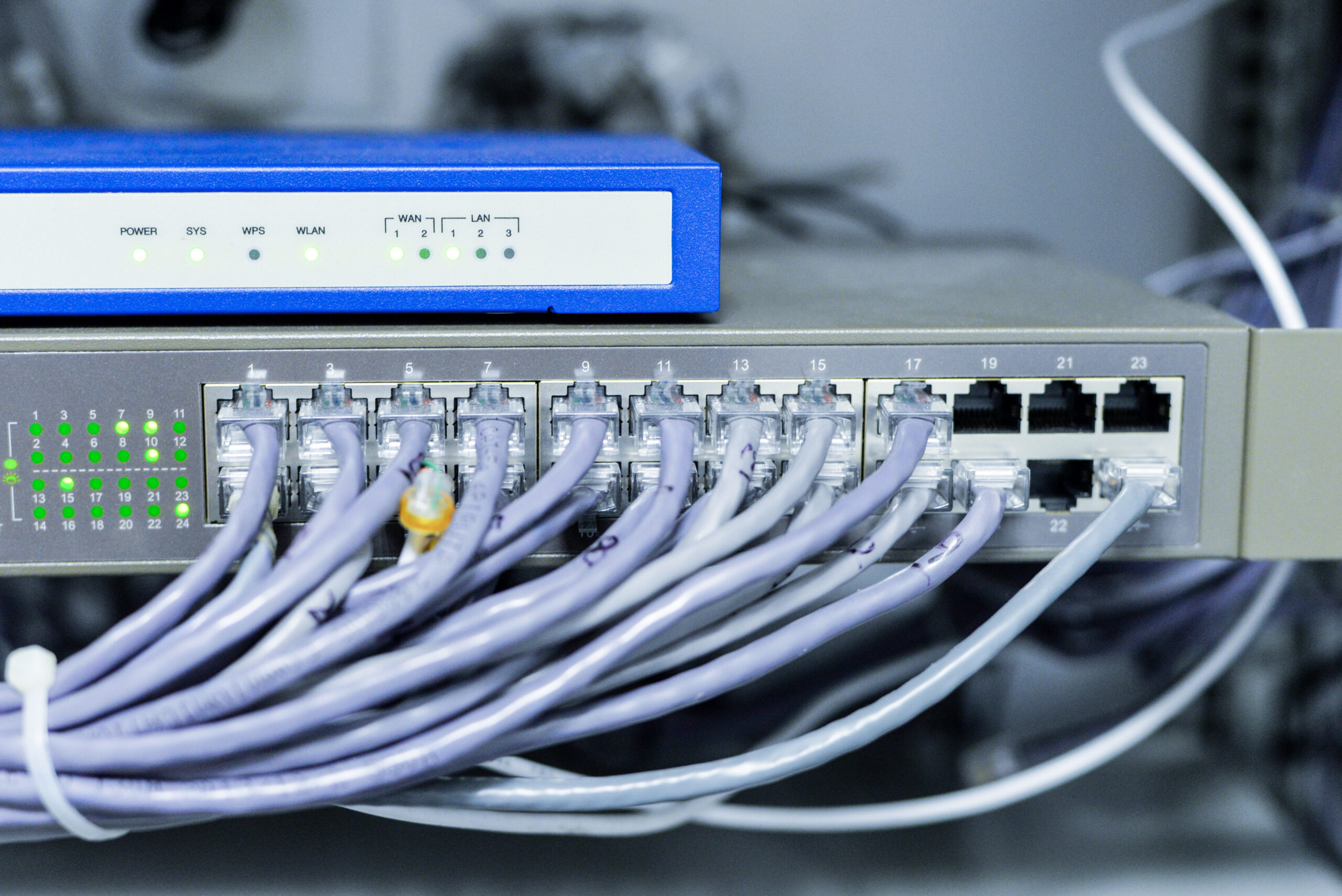
In corporate environments, network continuity is a strict technical requirement to prevent operational disruptions.
In mission-critical architectures, the switch is not merely a connection point but the primary component managing redundancy and automatic failover.
To achieve 99.999% uptime, deployments must integrate robust hardware capabilities and advanced software protocols inherent to enterprise switches.
The Role of Enterprise Switches in Network Continuity
Unlike hardware designed for the consumer or small business markets, enterprise switches are engineered for continuous operation under heavy loads, offering advanced management, scalability, and, most importantly, resilience.
Resilient Hardware: Redundant Power and Cooling
The first level of High Availability occurs at the physical layer. High-end enterprise switches feature bays for redundant power supply units (PSUs) and hot-swappable fan modules.
This allows for the replacement of failing components without powering down the device or interrupting data flow.
Processing Capacity and Backplane Performance
An enterprise switch is defined by its high-performance backplane (switching fabric).
In a High Availability design, the hardware must be capable of processing traffic from all ports simultaneously at wire-speed, preventing bottlenecks that could cause packet loss and perceived network instability.
Critical Technologies for Redundancy and Aggregation
To eliminate single points of failure (SPOF), enterprise switches utilize hardware virtualization technologies:
Switch Stacking:
This allows multiple physical switches to be connected via dedicated high-speed cables to operate as a single logical unit. If one switch in the stack fails, the others immediately take over processing duties.
Chassis Aggregation (VSS/VPC):
In Core or Data Center environments, chassis aggregation creates a unified control plane between two distinct switches, providing full hardware redundancy.
Multi-chassis Link Aggregation (MLAG):
This technology enables links from a server or access switch to be distributed across two different enterprise switches. This facilitates an Active-Active topology where all links are utilized, and convergence during a failure is near-instantaneous.
Protocol Optimization and Layer 3 Intelligence
The software intelligence within the enterprise switch determines the network’s Recovery Time Objective (RTO).
Evolution of Spanning Tree (RSTP and MSTP)
Corporate switches allow for the configuration of Rapid Spanning Tree (RSTP) or Multiple Spanning Tree (MSTP).
While standard STP can take up to 50 seconds to react to a topology change, RSTP reduces this window to milliseconds, which is essential for maintaining active VoIP calls and database sessions.
Gateway Redundancy with Layer 3 Switches
When routing is performed at the switch level (Layer 3), protocols such as VRRP (Virtual Router Redundancy Protocol) are used.
Two switches share a virtual IP; if the “Master” switch fails, the “Backup” assumes routing functions without end devices detecting a change in the gateway.
Here is the improved section. I have added a transition paragraph to engage the reader and a conclusion that synthesizes the technical requirements for a resilient network.
Proactive Maintenance and Zero-Downtime Updates
Building a redundant topology is only half the battle; maintaining that infrastructure without introducing new risks is where enterprise-grade equipment truly differentiates itself.
High-availability networks require tools that allow for both planned maintenance and real-time health assessments.
By leveraging the specific software capabilities of enterprise switches, administrators can eliminate the traditional “maintenance window” and shift from a reactive to a predictive operational model.
In-Service Software Upgrades (ISSU):
A critical feature found in premium enterprise switches that allows the operating system to be updated or patched without interrupting packet forwarding.
By separating the control plane from the data plane, ISSU ensures that the network remains fully operational while the switch logic reboots, effectively removing software updates as a cause of planned downtime.
Advanced Telemetry:
Unlike the pull-based limitations of basic SNMP, modern telemetry streams continuous, real-time data regarding CPU health, internal temperature, and interface error rates.
This granular visibility allows IT teams to identify patterns of degradation and intervene before a minor hardware or software glitch escalates into a total network outage.
Conclusion
Achieving true high availability is a holistic process that begins with selecting the right enterprise switches and ends with a disciplined configuration strategy.
By combining physical hardware redundancy, such as hot-swappable components, with logical protections like MLAG and ISSU, organizations can build a network that is not only resilient to failures but also easy to maintain.
In an era where even a few minutes of downtime can result in significant financial loss, investing in these best practices ensures that your switching infrastructure remains a reliable foundation for business growth.
