

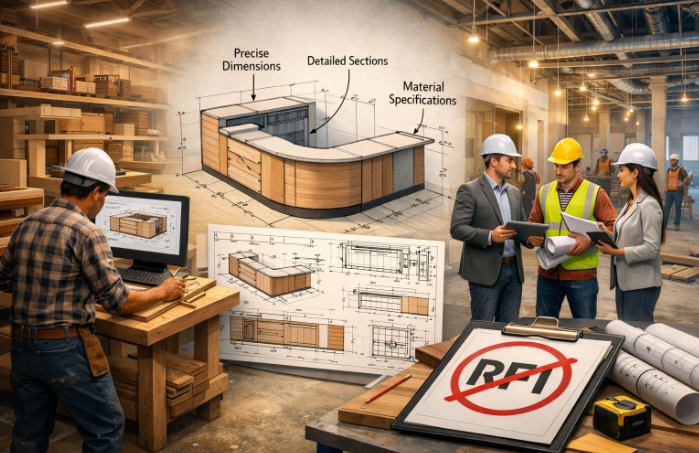
Despite rapid advances in digital construction technologies, Requests for Information (RFIs) remain one of the biggest pain points in commercial building projects. Architects, contractors, and developers across the UK and global markets still lose valuable time and money clarifying unclear drawings, missing details, or conflicting design information.
According to industry research by Autodesk Construction Cloud, RFIs contribute significantly to project delays and rework, often increasing construction costs by 5–10%. In complex interiors especially those involving bespoke joinery, cabinetry, and architectural woodwork the risk is even higher.
This is where custom millwork drafting plays a critical role. By delivering precise, build-ready millwork CAD details, project teams can dramatically reduce RFIs, streamline approvals, and improve collaboration across stakeholders.
What is custom millwork drafting in commercial construction?
Custom millwork drafting is the process of creating highly detailed CAD drawings for bespoke woodwork elements such as:
- Reception desks
- Wall panelling and cladding
- Retail fixtures
- Casework and cabinetry
- Hotel and office interiors
- Architectural joinery
Unlike generic shop drawings, custom millwork drafting focuses on project-specific fabrication requirements, materials, tolerances, finishes, and installation methods.
Professional millwork drafting services translate architectural intent into precise technical documentation that manufacturers and installers can rely on without ambiguity.
Why do RFIs frequently occur in millwork and interior packages?
Lack of detail is the biggest trigger
Most RFIs related to millwork arise because drawings are:
- Too conceptual
- Missing dimensions or tolerances
- Not coordinated with MEP or structural layouts
- Inconsistent across drawings
- Silent on materials, finishes, or joinery methods
A report by the UK National Building Specification (NBS) highlights that poor-quality design information is one of the top causes of construction inefficiency in the UK.
When contractors and fabricators encounter unclear millwork CAD details, they have no choice but to raise RFIs—slowing down procurement, fabrication, and site execution.
How does custom millwork drafting reduce RFIs?
1. By eliminating ambiguity before construction begins
Custom millwork drafting replaces assumptions with clarity.
Well-prepared millwork drawings clearly define:
- Exact dimensions and tolerances
- Joinery details and fixing methods
- Material specifications and finishes
- Interface points with walls, floors, ceilings, and services
This level of precision significantly reduces the “interpretation gap” that leads to RFIs.
2. By improving coordination with architectural, MEP, and structural plans
One of the most common sources of RFIs is design clashes.
Professional millwork drafting services ensure that millwork CAD details are:
- Aligned with reflected ceiling plans
- Coordinated with electrical and HVAC layouts
- Checked against structural constraints
According to McKinsey & Company, digitally coordinated design documentation can reduce rework by up to 40%, a major opportunity for complex commercial interiors.
3. By supporting faster approvals and sign-offs
When millwork drawings are clear and comprehensive, stakeholders ask fewer questions.
Custom millwork drafting helps:
- Architects approve shop drawings faster
- Clients visualise final outcomes more easily
- Contractors proceed without hesitation
Fewer comments mean fewer RFIs and smoother project momentum.
Why are millwork CAD details becoming more critical in UK projects?
Growing complexity in commercial interiors
UK commercial projects are becoming more design-driven and bespoke. Offices, hotels, healthcare facilities, and retail spaces increasingly rely on custom interiors to enhance user experience and brand identity.
This trend increases the demand for:
- High-accuracy millwork CAD details
- Fabrication-ready drawings
- Digitally coordinated documentation
The Construction Industry Council (CIC) continues to emphasise better design information management to meet modern construction demands across the UK.
How does custom millwork drafting support BIM and digital workflows?
Millwork drafting is no longer isolated from BIM
Today, many millwork drafting companies integrate CAD outputs with BIM workflows to improve information flow.
Benefits include:
- Seamless coordination with Revit or BIM models
- Reduced data loss between design stages
- Improved traceability and version control
This integration aligns with the UK’s push for digital construction standards and better project data management, particularly on publicly funded projects.
What are the measurable benefits of reducing RFIs through millwork drafting?
Tangible business and project outcomes
Reducing RFIs isn’t just a technical win, it’s a commercial advantage.
Key benefits include:
- Shorter project timelines
- Lower administrative overhead
- Reduced rework and wastage
- Improved contractor relationships
- Higher confidence during fabrication and installation
Research from RICS suggests that clearer construction documentation significantly improves cost certainty, something every commercial stakeholder values.
Why do architects and contractors increasingly outsource millwork drafting services?
Access to specialised expertise
Many architecture and construction firms outsource millwork drafting to specialist providers because:
- In-house teams are overstretched
- Millwork requires niche detailing expertise
- Outsourcing offers scalability without fixed overheads
A dedicated millwork drafting company brings focused experience in joinery standards, fabrication workflows, and installation sequencing reducing the likelihood of RFIs from the outset.
What should decision-makers look for in custom millwork drafting services?
If reducing RFIs is the goal, quality matters.
Key indicators of effective millwork drafting include:
- Proven experience in commercial interiors
- Strong coordination processes
- Clear annotation and layering standards
- Familiarity with UK construction practices
- Ability to deliver fabrication-ready millwork CAD details
Choosing the right drafting partner can directly influence project efficiency and risk reduction.
How does custom millwork drafting support better collaboration?
Clear drawings create aligned teams
RFIs often reflect misalignment, not just missing information.
Custom millwork drafting improves collaboration by:
- Providing a single source of truth
- Reducing back-and-forth communication
- Supporting transparent decision-making
When everyone works from the same accurate drawings, trust increases and friction decreases.
Final thoughts:
As commercial projects become more complex and timelines tighter, relying on vague or generic interior drawings is a risk few businesses can afford.
Custom millwork drafting offers a practical, proven way to reduce RFIs, improve coordination, and deliver commercial interiors with greater confidence and efficiency.
For UK and global project teams aiming to minimise delays and maximise clarity, investing in high-quality millwork drafting services is not just a technical choice it’s a strategic one.
In conclusion, many forward-thinking organisations now collaborate with experienced UK-based CAD design and drafting specialists who understand commercial construction realities and deliver millwork CAD details that work on site not just on screen.
FAQs
What is custom millwork drafting in commercial projects?
Custom millwork drafting is the process of creating highly detailed CAD drawings for bespoke interior woodwork such as cabinetry, wall panels, and fixtures. These drawings include exact dimensions, materials, finishes, and installation details, helping contractors and fabricators work without confusion and reducing RFIs during construction.
How does custom millwork drafting reduce RFIs?
Custom millwork drafting reduces RFIs by eliminating unclear or missing information in drawings. Detailed millwork CAD details clearly define joinery methods, tolerances, and coordination points, allowing contractors to proceed without raising clarification requests.
Why are RFIs common in millwork and interior fit-out projects?
RFIs are common in millwork projects due to incomplete drawings, design inconsistencies, and poor coordination with architectural or MEP plans. Without precise millwork drafting services, contractors must seek clarification, causing delays and cost overruns.
Are millwork drafting services important for commercial projects in the UK?
Yes. In the UK, commercial construction projects often involve complex interiors and strict coordination standards. Professional millwork drafting services help meet quality expectations, reduce design risks, and align with modern digital construction workflows.
What are millwork CAD details and why do they matter?
Millwork CAD details include shop-level drawings showing fabrication methods, material specifications, fixing details, and installation sequences. These details are critical for reducing errors, preventing RFIs, and ensuring millwork is built exactly as designed.
Can custom millwork drafting support BIM workflows?
Yes. Many millwork drafting companies integrate CAD drawings with BIM workflows, enabling better coordination, clash detection, and information accuracy especially important for large commercial and UK public-sector projects.
Who should use custom millwork drafting services?
Custom millwork drafting services are ideal for:
- Commercial architects
- Fit-out contractors
- Developers and business owners
- Joinery manufacturers
- Design–build firms
Any project involving bespoke interiors can benefit from reduced RFIs and improved build clarity.
Is outsourcing millwork drafting better than in-house drafting?
Outsourcing to a specialist millwork drafting company often delivers better accuracy, faster turnaround, and access to experienced CAD professionals without the overhead costs of maintaining in-house drafting teams.
How does reducing RFIs impact project cost and timelines?
Reducing RFIs helps avoid delays, rework, and miscommunication. Fewer RFIs lead to faster approvals, smoother fabrication, and better cost control key priorities in commercial construction projects.
What should I look for in a millwork drafting company in the UK?
Look for a millwork drafting company with:
- Commercial project experience
- Strong coordination standards
- High-quality millwork CAD details
- Knowledge of UK construction practices
- Proven RFI-reduction workflows
